

How To Show That A Set Is Countable
In mathematics, a set is countable if it has the same cardinality (the number of elements of the set up) as some subset of the set of natural numbers N = {0, i, 2, iii, ...}. Equivalently, a set S is countable if there exists an injective part f : S → N from Southward to N; information technology simply means that every element in S corresponds to a dissimilar chemical element in Northward.
A countable set is either a finite prepare or a countably space set up. Whether finite or infinite, the elements of a countable fix tin can e'er be counted one at a fourth dimension and — although the counting may never end due to the infinite number of the elements to be counted — every chemical element of the set is associated with a unique natural number.
Georg Cantor introduced the concept of countable sets, contrasting sets that are countable with those that are uncountable. Today, countable sets form the foundation of a branch of mathematics called detached mathematics.
A note on terminology [edit]
Although the terms "countable" and "countably infinite" equally defined hither are quite common, the terminology is non universal.[one] An alternative style uses countable to mean what is here called countably space, and at near countable to mean what is here called countable.[2] [3] To avoid ambivalence, one may limit oneself to the terms "at nearly countable" and "countably infinite", although with respect to concision this is the worst of both worlds.[ citation needed ] The reader is advised to check the definition in utilise when encountering the term "countable" in the literature.
The terms enumerable [4] and denumerable [five] [6] may as well be used, eastward.g. referring to countable and countably infinite respectively,[7] merely every bit definitions vary the reader is once over again advised to check the definition in utilise.[8]
Definition [edit]
The nearly concise definition is in terms of cardinality. A set Due south is countable if its cardinality |S| is less than or equal to (aleph-null), the cardinality of the ready of natural numbers N. A set S is countably infinite if . A ready is uncountable if it is non countable, i.east. its cardinality is greater than ; the reader is referred to Uncountable set for farther discussion.[nine]


For every ready S, the following propositions are equivalent:
- S is countable.[v]
- There exists an injective part from Due south to Northward.[10] [11]
- Due south is empty or at that place exists a surjective office from N to S.[11]
- At that place exists a bijective mapping between S and a subset of N.[12]
- S is either finite or countably infinite.[13]
Similarly, the following propositions are equivalent:
History [edit]
In 1874, in his first set theory commodity, Cantor proved that the gear up of existent numbers is uncountable, thus showing that not all space sets are countable.[17] In 1878, he used i-to-one correspondences to define and compare cardinalities.[xviii] In 1883, he extended the natural numbers with his infinite ordinals, and used sets of ordinals to produce an infinity of sets having dissimilar space cardinalities.[nineteen]
Introduction [edit]
A set up is a collection of elements, and may exist described in many ways. 1 mode is merely to list all of its elements; for example, the fix consisting of the integers 3, 4, and 5 may be denoted {iii, 4, v}, called roster form.[20] This is but effective for small sets, still; for larger sets, this would be time-consuming and fault-decumbent. Instead of listing every unmarried element, sometimes an ellipsis ("...") is used to represent many elements betwixt the starting element and the end element in a fix, if the writer believes that the reader can easily estimate what ... represents; for example, {i, two, 3, ..., 100} presumably denotes the set of integers from one to 100. Even in this example, even so, it is notwithstanding possible to listing all the elements, because number of elements in the fix is finite.
Some sets are space; these sets have more than n elements where northward is any integer that can be specified. (No matter how big the specified integer n is, such as northward = 9×ten32 , infinite sets have more than n elements.) For example, the set of natural numbers, denotable by {0, 1, two, 3, iv, v, ...},[a] has infinitely many elements, and nosotros cannot employ whatever natural number to give its size. Nonetheless, it turns out that infinite sets do have a well-defined notion of size (or more properly, cardinality, the technical term for the number of elements in a prepare), and non all infinite sets accept the aforementioned cardinality.

Bijective mapping from integer to even numbers
To sympathise what this means, we outset examine what it does not mean. For example, at that place are infinitely many odd integers, infinitely many even integers, and (hence) infinitely many integers overall. Still, it turns out that the number of even integers, which is the aforementioned every bit the number of odd integers, is also the same as the number of integers overall. This is considering we can accommodate things such that, for every integer, in that location is a distinct fifty-fifty integer:

or, more than mostly, (see picture). What nosotros have done here is conform the integers and the even integers into a one-to-one correspondence (or bijection), which is a function that maps betwixt two sets such that each element of each set up corresponds to a unmarried chemical element in the other set.

Even so, not all infinite sets take the same cardinality. For example, Georg Cantor (who introduced this concept) demonstrated that the real numbers cannot exist put into 1-to-one correspondence with the natural numbers (non-negative integers), and therefore that the set up of existent numbers has a greater cardinality than the set of natural numbers.
Formal overview [edit]
By definition, a set S is countable if there exists an injective function f : South → N from S to the natural numbers North = {0, 1, 2, 3, ...}. It only means that every element in South has the correspondence to a different element in N .
It might seem natural to divide the sets into different classes: put all the sets containing one chemical element together; all the sets containing two elements together; ...; finally, put together all infinite sets and consider them as having the same size. This view is non tenable, however, under the natural definition of size.
To elaborate this, we demand the concept of a bijection. Although a "bijection" may seem a more advanced concept than a number, the usual development of mathematics in terms of set theory defines functions before numbers, as they are based on much simpler sets. This is where the concept of a bijection comes in: define the correspondence
a ↔ 1, b ↔ 2, c ↔ 3
Since every element of {a, b, c} is paired with precisely ane chemical element of {1, 2, three}, and vice versa, this defines a bijection.
Nosotros at present generalize this situation; we define that 2 sets are of the same size, if and just if there is a bijection between them. For all finite sets, this gives us the usual definition of "the same size".
Every bit for the case of infinite sets, consider the sets A = {1, 2, iii, ... }, the set of positive integers, and B = {two, 4, 6, ... }, the gear up of even positive integers. We merits that, under our definition, these sets have the aforementioned size, and that therefore B is countably space. Retrieve that to bear witness this, we need to exhibit a bijection between them. This tin be achieved using the assignment n ↔ iin, and so that
one ↔ 2, two ↔ iv, iii ↔ 6, 4 ↔ 8, ....
Equally in the before example, every chemical element of A has been paired off with precisely one element of B, and vice versa. Hence they have the aforementioned size. This is an example of a set of the same size as one of its proper subsets, which is incommunicable for finite sets.
Besides, the ready of all ordered pairs of natural numbers (the Cartesian production of two sets of natural numbers, N × N) is countably infinite, as can be seen by following a path like the 1 in the picture:

The resulting mapping gain as follows:
0 ↔ (0, 0), 1 ↔ (1, 0), 2 ↔ (0, i), 3 ↔ (2, 0), four ↔ (1, 1), 5 ↔ (0, two), 6 ↔ (3, 0), ....
This mapping covers all such ordered pairs.
This form of triangular mapping recursively generalizes to northward-tuples of natural numbers, i.e., (a 1, a 2, a 3, ..., a northward) where ai and n are natural numbers, by repeatedly mapping the kickoff two elements of a n-tuple to a natural number. For example, (0, two, 3) can be written equally ((0, 2), 3). Then (0, 2) maps to 5 and then ((0, 2), 3) maps to (5, iii), and so (five, 3) maps to 39. Since a different ii-tuple, that is a pair such as (a, b), maps to a different natural number, a difference between two northward-tuples by a single element is plenty to ensure the n-tuples being mapped to different natural numbers. So, an injection from the set of n-tuples to the set of natural numbers Due north is proved. For the set of due north-tuples made by the Cartesian product of finitely many different sets, each element in each tuple has the correspondence to a natural number, and so every tuple can be written in natural numbers so the same logic is practical to prove the theorem.
Theorem —The Cartesian product of finitely many countable sets is countable.[21] [b]
The gear up of all integers Z and the fix of all rational numbers Q may intuitively seem much bigger than N. But looks can be deceiving. If a pair is treated as the numerator and denominator of a vulgar fraction (a fraction in the class of a/b where a and b ≠ 0 are integers), then for every positive fraction, we can come upward with a distinct natural number corresponding to it. This representation also includes the natural numbers, since every natural number is besides a fraction N/1. And then we tin can conclude that there are exactly as many positive rational numbers every bit there are positive integers. This is also truthful for all rational numbers, as can be seen below.
Theorem — Z (the set up of all integers) and Q (the set up of all rational numbers) are countable.[c]
In a like manner, the gear up of algebraic numbers is countable.[23] [d]
Sometimes more than one mapping is useful: a fix A to be shown as countable is one-to-1 mapped (injection) to some other set B, then A is proved every bit countable if B is i-to-ane mapped to the set of natural numbers. For example, the ready of positive rational numbers can hands be one-to-1 mapped to the set of natural number pairs (2-tuples) because p/q maps to (p, q). Since the set of natural number pairs is one-to-one mapped (really ane-to-1 correspondence or bijection) to the set of natural numbers as shown in a higher place, the positive rational number set is proved every bit countable.
Theorem —Whatever finite spousal relationship of countable sets is countable.[24] [25] [e]
With the foresight of knowing that there are uncountable sets, we tin can wonder whether or not this last result tin can be pushed any further. The reply is "yes" and "no", nosotros can extend it, simply we demand to presume a new axiom to do then.
Theorem —(Assuming the axiom of countable choice) The union of countably many countable sets is countable.[f]
For example, given countable sets a, b, c, ...
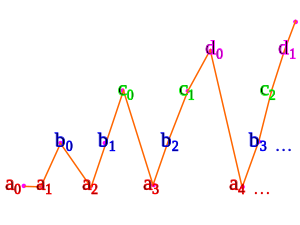
Enumeration for countable number of countable sets
Using a variant of the triangular enumeration nosotros saw above:
- a 0 maps to 0
- a one maps to 1
- b 0 maps to 2
- a 2 maps to 3
- b one maps to 4
- c 0 maps to 5
- a iii maps to 6
- b 2 maps to seven
- c 1 maps to 8
- d 0 maps to 9
- a iv maps to 10
- ...
This only works if the sets a, b, c, ... are disjoint. If not, then the union is even smaller and is therefore also countable by a previous theorem.
Nosotros need the axiom of countable choice to index all the sets a, b, c, ... simultaneously.
Theorem —The fix of all finite-length sequences of natural numbers is countable.
This ready is the union of the length-1 sequences, the length-2 sequences, the length-3 sequences, each of which is a countable prepare (finite Cartesian product). And so we are talking well-nigh a countable union of countable sets, which is countable by the previous theorem.
Theorem —The gear up of all finite subsets of the natural numbers is countable.
The elements of any finite subset can exist ordered into a finite sequence. There are simply countably many finite sequences, so also there are only countably many finite subsets.
Theorem —Permit S and T be sets.
- If the function f : South → T is injective and T is countable then S is countable.
- If the function 1000 : S → T is surjective and S is countable then T is countable.
These follow from the definitions of countable prepare as injective / surjective functions.[g]
Cantor's theorem asserts that if A is a set and P(A) is its ability set, i.e. the set of all subsets of A, then there is no surjective office from A to P(A). A proof is given in the article Cantor'south theorem. As an immediate consequence of this and the Basic Theorem in a higher place we have:
Proposition —The fix P(N) is not countable; i.e. it is uncountable.
For an elaboration of this result run into Cantor's diagonal argument.
The set of real numbers is uncountable,[h] and and so is the set of all space sequences of natural numbers.
Minimal model of set theory is countable [edit]
If there is a gear up that is a standard model (see inner model) of ZFC prepare theory, then at that place is a minimal standard model (see Constructible universe). The Löwenheim–Skolem theorem can be used to show that this minimal model is countable. The fact that the notion of "uncountability" makes sense even in this model, and in detail that this model M contains elements that are:
- subsets of M, hence countable,
- but uncountable from the point of view of M,
was seen equally paradoxical in the early on days of set theory, see Skolem's paradox for more.
The minimal standard model includes all the algebraic numbers and all effectively computable transcendental numbers, likewise as many other kinds of numbers.
Total orders [edit]
Countable sets tin exist totally ordered in various ways, for case:
- Well-orders (run into also ordinal number):
- The usual order of natural numbers (0, one, 2, iii, iv, 5, ...)
- The integers in the guild (0, 1, ii, 3, ...; −1, −2, −3, ...)
- Other (not well orders):
- The usual order of integers (..., −3, −2, −1, 0, one, two, 3, ...)
- The usual society of rational numbers (Cannot exist explicitly written every bit an ordered list!)
In both examples of well orders here, whatsoever subset has a least chemical element; and in both examples of non-well orders, some subsets exercise not have a least element. This is the key definition that determines whether a full order is also a well lodge.
See also [edit]
- Aleph number
- Counting
- Hilbert'south paradox of the Grand Hotel
- Uncountable set
Notes [edit]
- ^ Since at that place is an obvious bijection between Due north and N* = {1, two, iii, ...}, information technology makes no difference whether i considers 0 a natural number or not. In any case, this commodity follows ISO 31-xi and the standard convention in mathematical logic, which takes 0 as a natural number.
- ^ Proof: Observe that North × N is countable equally a consequence of the definition considering the function f : Due north × N → N given by f(yard, northward) = ii chiliad 3 due north is injective.[22] It and so follows that the Cartesian product of whatsoever ii countable sets is countable, because if A and B are two countable sets there are surjections f : Northward → A and yard : N → B . So
f × 1000 : Northward × N → A × B
is a surjection from the countable fix N × North to the set up A × B and the Corollary implies A × B is countable. This result generalizes to the Cartesian product of whatsoever finite drove of countable sets and the proof follows by consecration on the number of sets in the collection.
- ^ Proof: The integers Z are countable because the function f : Z → Due north given past f(due north) = 2 northward if n is non-negative and f(n) = three−n if north is negative, is an injective function. The rational numbers Q are countable because the function g : Z × N → Q given by g(g, northward) = m/(n + 1) is a surjection from the countable gear up Z × Due north to the rationals Q .
- ^ Proof: Per definition, every algebraic number (including circuitous numbers) is a root of a polynomial with integer coefficients. Given an algebraic number , allow be a polynomial with integer coefficients such that is the kth root of the polynomial, where the roots are sorted past accented value from small to big, then sorted by argument from minor to big. We can ascertain an injection (i. e. one-to-one) function f : A → Q given by , while is the n-thursday prime number.
- ^ Proof: If Ai is a countable set for each i in I={1,...,n}, then for each n there is a surjective function gi : North → Ai and hence the function given by G(i, m) = gi (chiliad) is a surjection. Since I × N is countable, the union is countable.
- ^ Proof: As in the finite instance, simply I=N and we apply the axiom of countable choice to pick for each i in N a surjection 1000i from the non-empty drove of surjections from Northward to Ai .
- ^ Proof: For (1) observe that if T is countable in that location is an injective part h : T → N. Then if f : S → T is injective the composition h o f : South → North is injective, and so S is countable. For (2) observe that if S is countable, either Due south is empty or there is a surjective function h : North → S. Then if thousand : Due south → T is surjective, either Southward and T are both empty, or the composition thousand o h : N → T is surjective. In either case T is countable.
- ^ See Cantor's first uncountability proof, and too Finite intersection property#Applications for a topological proof.


Citations [edit]
- ^ Manetti, Marco (19 June 2022). Topology. Springer. p. 26. ISBN978-3-319-16958-3.
- ^ Rudin 1976, Affiliate ii
- ^ Tao 2022, p. 181
- ^ Kamke 1950, p. ii
- ^ a b Lang 1993, §2 of Chapter I
- ^ Apostol 1969, p. 23, Chapter ane.14
- ^ Thierry, Vialar (four April 2022). Handbook of Mathematics. BoD - Books on Need. p. 24. ISBN978-ii-9551990-1-5.
- ^ Mukherjee, Subir Kumar (2009). Outset Course in Real Analysis. Academic Publishers. p. 22. ISBN978-81-89781-xc-3.
- ^ Yaqub, Aladdin M. (24 October 2022). An Introduction to Metalogic. Broadview Press. ISBN978-1-4604-0244-3.
- ^ Singh, Tej Bahadur (17 May 2022). Introduction to Topology. Springer. p. 422. ISBN978-981-xiii-6954-4.
- ^ a b Katzourakis, Nikolaos; Varvaruca, Eugen (2 January 2022). An Illustrative Introduction to Modern Analysis. CRC Press. ISBN978-1-351-76532-nine.
- ^ Halmos 1960, p. 91
- ^ Weisstein, Eric West. "Countable Gear up". mathworld.wolfram.com . Retrieved 2020-09-06 .
- ^ Kamke 1950, p. ii
- ^ Dlab, Vlastimil; Williams, Kenneth Southward. (9 June 2022). Invitation To Algebra: A Resources Compendium For Teachers, Advanced Undergraduate Students And Graduate Students In Mathematics. Earth Scientific. p. 8. ISBN978-981-12-1999-3.
- ^ Tao 2022, p. 182
- ^ Stillwell, John C. (2010), Roads to Infinity: The Mathematics of Truth and Proof, CRC Press, p. 10, ISBN9781439865507,
Cantor's discovery of uncountable sets in 1874 was one of the almost unexpected events in the history of mathematics. Before 1874, infinity was non fifty-fifty considered a legitimate mathematical discipline past most people, so the demand to distinguish between countable and uncountable infinities could non have been imagined.
- ^ Cantor 1878, p. 242.
- ^ Ferreirós 2007, pp. 268, 272–273.
- ^ "What Are Sets and Roster Form?". expii. 2022-05-09. Archived from the original on 2022-09-eighteen.
- ^ Halmos 1960, p. 92
- ^ Avelsgaard 1990, p. 182
- ^ Kamke 1950, pp. 3–4
- ^ Avelsgaard 1990, p. 180
- ^ Fletcher & Patty 1988, p. 187
References [edit]
- Apostol, Tom Chiliad. (June 1969), Multi-Variable Calculus and Linear Algebra with Applications , Calculus, vol. 2 (2nd ed.), New York: John Wiley + Sons, ISBN978-0-471-00007-5
- Avelsgaard, Carol (1990), Foundations for Advanced Mathematics, Scott, Foresman and Company, ISBN0-673-38152-8
- Cantor, Georg (1878), "Ein Beitrag zur Mannigfaltigkeitslehre", Journal für die Reine und Angewandte Mathematik, 1878 (84): 242–248, doi:10.1515/crelle-1878-18788413
- Ferreirós, José (2007), Labyrinth of Idea: A History of Set Theory and Its Function in Mathematical Idea (2nd revised ed.), Birkhäuser, ISBN978-iii-7643-8349-seven
- Fletcher, Peter; Patty, C. Wayne (1988), Foundations of Higher Mathematics, Boston: PWS-KENT Publishing Company, ISBN0-87150-164-iii
- Halmos, Paul R. (1960), Naive Set Theory, D. Van Nostrand Visitor, Inc Reprinted by Springer-Verlag, New York, 1974. ISBN 0-387-90092-6 (Springer-Verlag edition). Reprinted past Martino Fine Books, 2022. ISBN 978-1-61427-131-4 (Paperback edition).
- Kamke, Erich (1950), Theory of Sets, Dover series in mathematics and physics, New York: Dover, ISBN978-0486601410
- Lang, Serge (1993), Real and Functional Analysis, Berlin, New York: Springer-Verlag, ISBN0-387-94001-four
- Rudin, Walter (1976), Principles of Mathematical Analysis, New York: McGraw-Hill, ISBN0-07-054235-X
- Tao, Terence (2016). "Infinite sets". Assay I (Third ed.). Singapore: Springer. pp. 181–210. ISBN978-981-10-1789-6.
 | Look up countable in Wiktionary, the free dictionary. |
Source: https://en.wikipedia.org/wiki/Countable_set#:~:text=In%20mathematics%2C%20a%20set%20is,3%2C%20...%7D.
0 Response to "How To Show That A Set Is Countable"
Post a Comment